
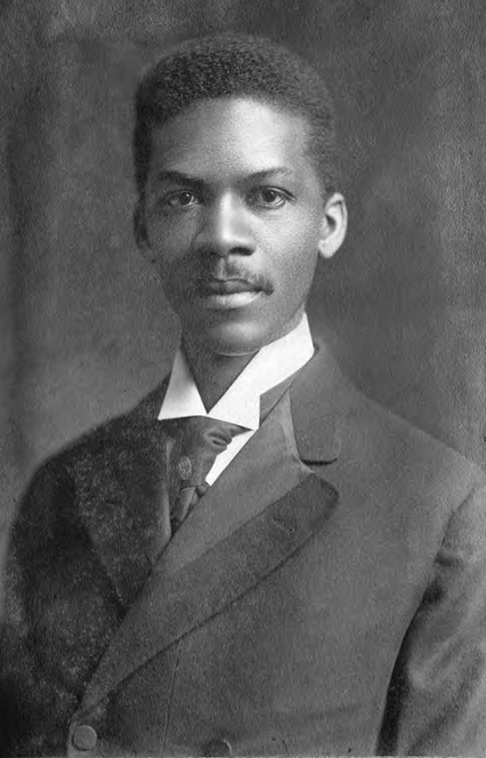
June 6 marks the birthday of one of the most courageous figures in Bahá'í history—Louis George Gregory, born on June 6th in 1874 in Charleston, South Carolina. His life stands as a testament to the transformative power of faith and the unrelenting commitment to justice and unity. Today, we celebrate a man who gave everything he had to advance the cause of racial amity in an America that was fundamentally hostile to such a vision.
From Slavery's Shadow to Howard's Halls
Louis Gregory entered the world only a few years after his parents' emancipation from slavery in rural Darlington County, South Carolina. This context is crucial to understanding his extraordinary journey. His parents had experienced the deepest injustice—the denial of freedom itself—yet they were determined their son would taste opportunity.
Gregory pursued education with fierce determination, attending the best institutions available to African Americans of his era. He studied at Charleston's Avery Institute, then went on to Fisk University in Nashville, one of the nation's historically black colleges founded in the aftermath of the Civil War. Finally, he attended the law school of Howard University in Washington, D.C., where he earned his degree and was admitted to the bar in 1902.
By the early 1900s, Gregory had established himself as a prominent figure in Washington's African American intellectual and cultural circles. He worked as an attorney at the U.S. Treasury Department, a significant position for a black man during the Jim Crow era. Beyond his legal career, he became active in the city's political and cultural life, serving as president of the Bethel Literary and Historical Society—one of the oldest African American cultural organizations in the nation's capital. A local newspaper, the Washington Bee, recognized him in 1905 as "one of the most gifted writers and speakers in this country." Success, by any measure available to him, was within his grasp.
And then he abandoned it all.
The Encounter That Changed Everything
In 1909, at the age of 35, Louis Gregory embraced the Bahá'í Faith. What drew an accomplished lawyer away from a promising career to devote himself to a small, obscure religious movement? Gregory was convinced that the Bahá'í spiritual and social teachings represented both a renewal of the spirit of Christianity and a solution to the problems of the modern world. Most importantly, he believed the Bahá'í Faith offered what no other institution in America was offering: a coherent vision of true racial unity.
In 1910, Gregory became the first person to introduce the Bahá'í Faith to the Southeast, including his native Charleston. But his most transformative encounter came two years later, when 'Abdu'l-Bahá—the son of the Bahá'í Faith's founder, Bahá'u'lláh—visited America for an extended tour. Gregory was distinguished by being the first African American invited by 'Abdu'l-Bahá to the Holy Land for pilgrimage.
The Dinner at the Persian Legation: A Small Act, A Radical Stand
On April 23, 1912, 'Abdu'l-Bahá spoke at Howard University, Gregory's own alma mater. The talk was historic—a leader from the Middle East addressing a predominantly African American audience with a message of spiritual equality. Following the address, 'Abdu'l-Bahá was the guest of honor at a reception hosted by the charge d'affaires of the Persian Legation at 1832 16th Street, NW, in Washington, D.C.
'Abdu'l-Bahá had asked Gregory to join him privately at the legation. But when dinner was announced, the awful social reality of 1912 America became starkly apparent. It was unthinkable in that era—across most of the nation, certainly in the nation's capital—for white people and black people to dine together at a formal dinner. Gregory, understanding the impossible position his presence would create, quietly tried to slip away.
What happened next became one of the most poignant moments in Bahá'í history.
'Abdu'l-Bahá suddenly stood and looked around the table. "Where is Mr. Gregory?" he asked. When told that Gregory was leaving, 'Abdu'l-Bahá turned to Ali-Kuli Khan, the charge d'affaires, and said simply: "Bring Mr. Gregory."
Khan had no choice but to retrieve Gregory, whom he found trying to exit unnoticed. When Gregory returned to the dining room, 'Abdu'l-Bahá took extraordinary action. He pushed aside all the utensils, plates, and glasses to his right—the place of honor—and had them removed entirely. He ordered a twentieth chair brought to the table and had new place settings arranged. Here, at the right hand of 'Abdu'l-Bahá himself, he seated Louis Gregory.
'Abdu'l-Bahá then sat down and, as if nothing out of the ordinary had just occurred, began to speak on racial prejudice.
The message was unmistakable: in the kingdom of God, there is no "color line." The most distinguished guest at the table—a spiritual leader from the Middle East, a man commanding international respect—chose to share his most intimate meal with a black man. 'Abdu'l-Bahá's actions spoke what his words would amplify: racial unity is not a secondary concern or a future ideal. It is a fundamental principle of faith.
"The Pupil of the Eye"
During his time in America, 'Abdu'l-Bahá introduced a powerful metaphor to reframe how the Bahá'í community understood race—and specifically, the African American experience. He told Louis Gregory directly: "I liken you to the pupil of the eye."
He elaborated on this profound image, referencing the words of Bahá'u'lláh himself: "Bahá'u'lláh once compared the colored people to the black pupil of the eye surrounded by the white. In this black pupil is seen the reflection of that which is before it, and through it the light of the spirit shineth forth."
Consider the depth of this metaphor. The pupil of the eye is not peripheral. It is not decorative. It is absolutely central—the very mechanism through which light enters and vision becomes possible. Without the pupil, the eye cannot see. Without the black pupil, there is no sight. 'Abdu'l-Bahá was telling Gregory, and through him, all African American Bahá'ís: you are not marginal to God's purpose. You are essential. You are the lens through which divine light is reflected into the world.
This metaphor became known as "the pupil of the eye"—a phrase that would echo through Bahá'í communities for generations, offering a radically different vision of racial identity and worth.
A Marriage That Changed History
In September 1912, 'Abdu'l-Bahá encouraged Louis Gregory to marry Louisa Mathew, a white English Bahá'í. They were married on September 27, 1912, in New York City, becoming the first Bahá'í interracial couple—and more significantly, the marriage was personally encouraged by 'Abdu'l-Bahá himself.
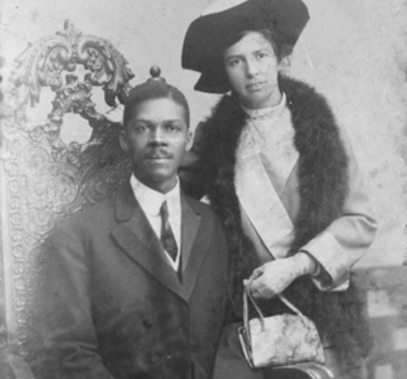
This was not a minor social event. In 1912 America, an interracial marriage was illegal in many states and profoundly shocking in all of them. That 'Abdu'l-Bahá would bless and encourage such a union was a radical statement about his commitment to racial unity as a spiritual principle, not merely a distant ideal.
Yet Gregory and his wife would spend much of their married life separated by the cruel realities of Jim Crow. When traveling through the South to teach the Bahá'í message, they often could not stay in the same hotels or eat in the same restaurants. They endured "the dangers and indignities of Jim Crow travel," in the words of one historian. Yet neither abandoned the work. Their marriage itself became a living testimony to the possibility of unity across the deepest divides.
A Life in Service: Forty Years of Teaching
For the next four decades, Gregory threw himself into spreading the Bahá'í message of racial unity. He became the mainspring behind the Bahá'í work for race amity in America. Over forty years, he visited 46 states, parts of Canada, Haiti, the Middle East, and Europe, presenting the Bahá'í teachings to gatherings large and small. He met with leaders of thought. He encouraged communities. He organized race amity conferences throughout the American South, in a region that remained profoundly resistant to any message of equality.
In 1922, Gregory was elected to the nine-member National Spiritual Assembly of the Baha'is of the United States and Canada—the first African American to hold such a position. He was repeatedly re-elected, serving with distinction for many years.
His work was not celebrated in the wider American society. The mainstream press largely ignored him. The legal profession that had once held such promise for him had been abandoned. He lived modestly, traveling constantly, often at his own expense, to spread a message that most of America rejected.
The Recognition That Came Too Late
On July 30, 1951, Louis Gregory died. That same year, posthumously, he was appointed as a Hand of the Cause by Shoghi Effendi, the Guardian of the Bahá'í Faith. This was the highest appointed rank in the Bahá'í community—and a recognition of his extraordinary service.
The honors that the world had withheld during his lifetime came after his death. But Gregory had not worked for recognition. He had worked because he believed in something larger than himself—a vision of humanity united across all lines of division, a future in which the light of the spirit would shine forth for all people.
A Birthday Reflection
On June 6, as we celebrate Louis Gregory's birthday 152 years after his birth, we do well to remember what his life teaches us. He chose the harder path. He abandoned security for service. He endured humiliation so that others might know dignity. He believed that real unity—not the superficial kind, but the deep spiritual unity that comes from recognizing the divine worth of every soul—was possible even in a time and place that seemed to deny it at every turn.
In his own words, Gregory described his mission simply: "To move the world." And in his quiet, steady way, he did. Through his example, his teaching, his marriage, his unwavering commitment, and his "pupil of the eye" metaphor, he moved the world toward a vision of racial unity that is still, even now, not fully realized.
The dinner at the Persian Legation in 1912 remains instructive. 'Abdu'l-Bahá's simple gesture—insisting that a black man sit at his right hand, pushing aside the social conventions of the time—reminds us that unity is not achieved through compromise or half-measures. It requires those with power and position to use it radically, to disturb the comfortable order of things, to say clearly: in God's eyes, we are one.
This is the legacy of Louis Gregory. This is why we celebrate his birthday. And this is why his life, a century and a half later, still calls us toward something higher than we have yet achieved.
Sources:
Breaking the Color Line - 239Days.com
Louis Gregory - 'Abdu'l-Bahá in America Centenary Project
Louis Gregory: Tireless Worker for Racial Amity - BahaiTeachings.org
The Pupil of the Eye: An Ennobling Racial Metaphor - BahaiTeachings.org
'Abdu'l-Bahá's Radical Approach to Race Unity - BahaiTeachings.org
To Move the World: Louis G. Gregory and the Advancement of Racial Unity in America by Gayle Morrison
0 Comments